By Rachel Courts, Alana Button
Initiatives aimed at improving access to postsecondary education (PSE) often centre on supporting students’ entry into PSE but fall short of considering what happens after they begin their studies. To fully support students’ access to higher education, a broader definition of access is needed — one that includes students’ persistence, graduation and transitions into the labour market. But what happens when students enroll in PSE but do not complete their studies? What does this mean for individual students, the Ontario government and Ontarians who have invested in PSE?
To fully support students’ access to higher education, a broader definition of access is needed.
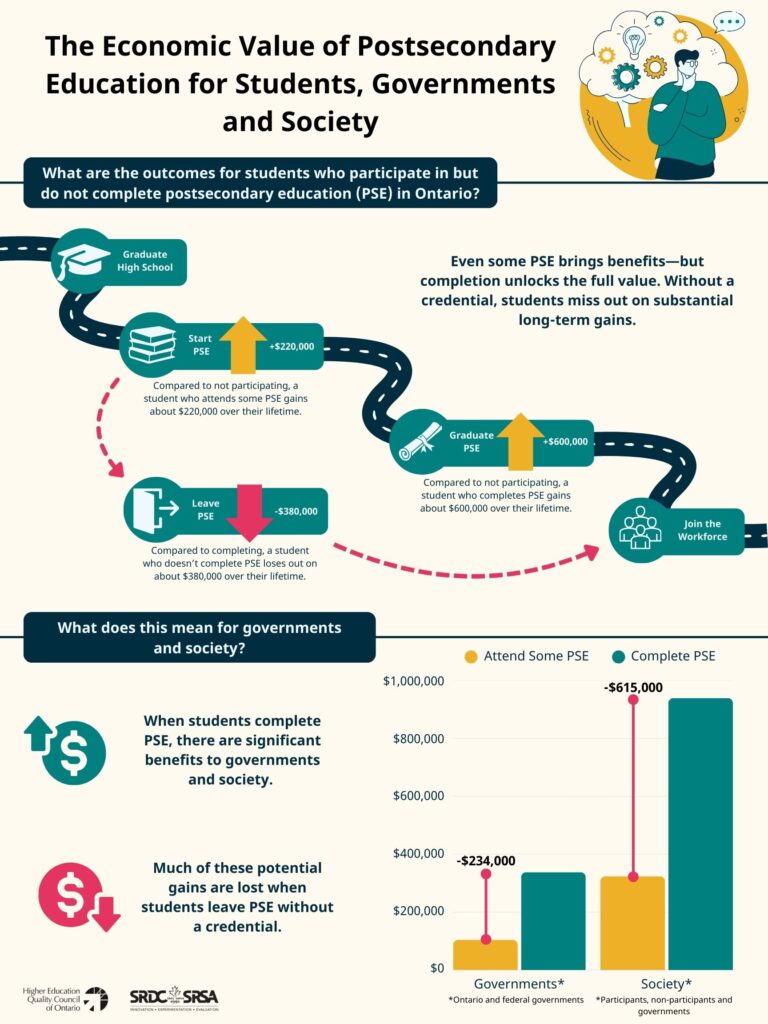
Since 2023, HEQCO has been working with the Social Research and Demonstration Corporation (SRDC) to examine PSE non-completion (that is, starting PSE and leaving without a credential) in Ontario. Our previous work explored postsecondary non-completion rates and labour market outcomes, and how these vary by students’ sociodemographic characteristics. In the next stage of this research, we investigated the financial costs of PSE completion and non-completion for students, governments and society. Using cost-benefit analytical techniques, SRDC compared costs and earnings over a 40-year period between individuals who participated in PSE (both non-completers and completers) and those who did not. SRDC used a variety of information sources to develop a cost–benefit model, including the Postsecondary Student Information System (PSIS), tuition data, Ontario Student Assistance Program (OSAP) data, data from the Education and Labour Market Longitudinal Platform (ELMLP) and the Census. Our infographic below illustrates the results of these analyses, which point to the value of PSE. Participating in PSE offers individual and collective value in a number of ways, including through improved health, social, civic and economic outcomes. Our work with SRDC focused on the latter, and from this research, the economic value of PSE is clear: participating in some PSE brings significant financial benefits to Ontarians and the Ontario government.
Participating in some PSE brings significant financial benefits to Ontarians and the Ontario government.
We learned that the average student financially benefits from their time in PSE, compared to if they had not participated at all. Those who complete PSE gain about $600,000 more than non-participants over their lifetime, mostly driven by increased earnings. Students who attend PSE but leave without a credential benefit too, with non-completing students gaining roughly $220,000 more compared to non-participants over their lifetime (again, largely driven by higher earnings).
But students are not the only ones who benefit from participating in PSE. Increased earnings bring higher tax revenues that more widely benefit governments and society. Compared to non-participants, when the average student attends some PSE but leaves without a credential, governments (including the Ontario and federal governments) benefit by about $104,000 over the student’s working lifetime and society benefits by about $324,000 over this same period. If the same student were to complete PSE, these benefits (compared to not attending) climb significantly — with governments gaining about $338,000 and society gaining about $939,000 over the student’s lifetime. These differences in outcomes between non-completers and completers translate to considerable losses for government and society: When a student leaves PSE without a credential, governments and society lose out on roughly $234,000 and $615,000, respectively, over the student’s lifetime. Financial losses mean lower tax revenues and social contributions, which hampers government’s ability to deliver crucial supports and services to Ontarians. Considering nearly a quarter of students who start PSE in Ontario do not complete, substantial benefits to governments and society are being left on the table. There is clear financial value in students participating in some PSE, but completing PSE delivers even more value.
There is clear financial value in students participating in some PSE, but completing PSE delivers even more value.
This work underscores the value of participation in PSE, not only for students, but for Ontarians and the Ontario government, too. When individuals attend PSE, we all reap considerable financial rewards, and these rewards increase when students earn a credential. Realizing the full value of PSE requires a broader understanding of access to ensure students are supported into and through PSE.
To learn more about HEQCO’s work with SRDC on the costs of non-completion, check out our summary of SRDC’s cost–benefit analysis and their full technical report.