
By Rachel Courts
In 2024, HEQCO explored the role of microcredentials in Ontario and found that these credentials are best suited to support adult learners to upskill rather than reskill — that is, to build upon existing skills rather than develop entirely new ones. We urged, however, that more complete and comprehensive data related to microcredential programs, learners and outcomes could be collected and shared to help inform program planning and policy analysis.
In our recommendations, we specifically noted the value of Ontario Student Assistance Program (OSAP) data, which could help shed light on which learners are accessing financial assistance to pursue microcredentials. In 2025, HEQCO gained access to this data, which reflects a subset of microcredential learners (those who received OSAP for microcredentials) for a subset of microcredential programs (those that are eligible for OSAP). While the data only captures a slice of Ontario’s microcredential landscape, it suggests awareness and uptake of microcredentials is growing.
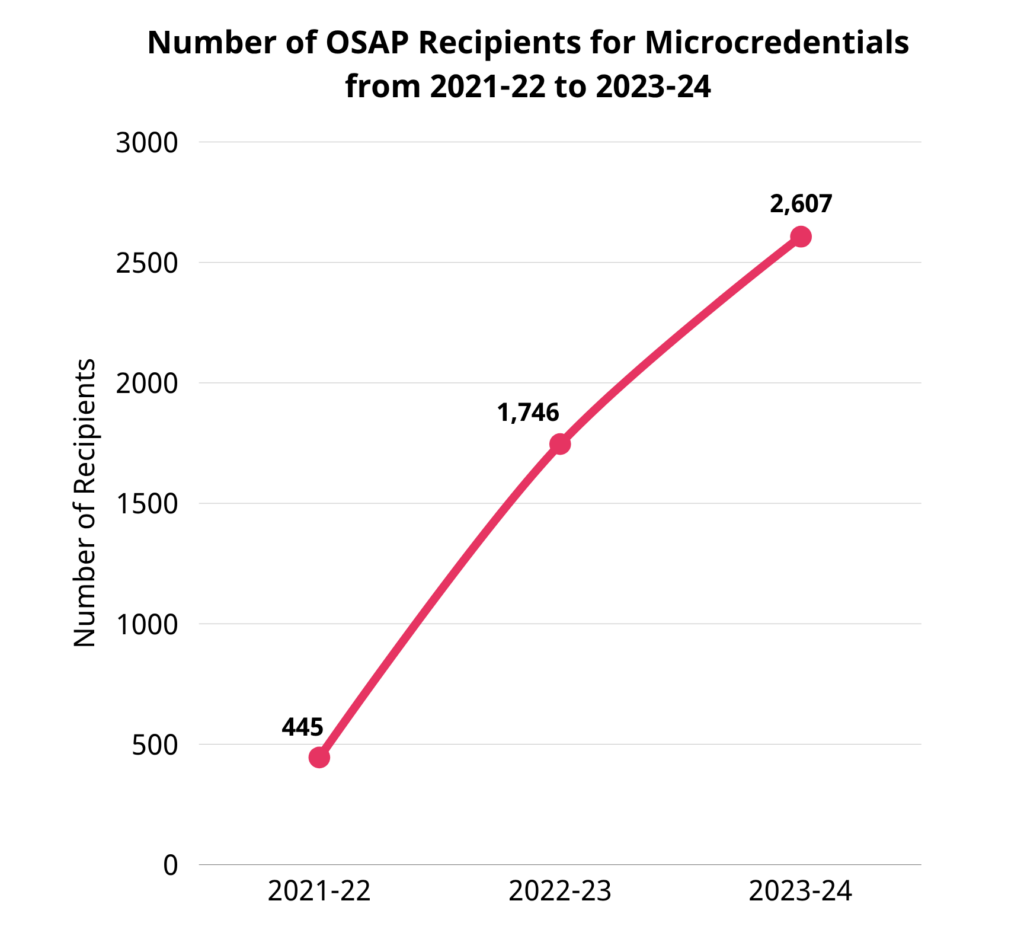
OSAP data suggests awareness and uptake of microcredentials is growing.
Available data include the number of recipients who received OSAP for microcredentials from 2021-22 to 2023-24, with breakdowns by institution type, gender, age and income. The number of recipients is based on application data, so recipients are counted once for every application where funding was issued. This means that recipients may be included in the sample more than once if they received funding for more than one application.
From 2021-22 to 2023-24, OSAP recipients for eligible microcredentials grew by 486%. Actual uptake, though, may be even higher given there are also learners who do not seek financial assistance to pursue microcredentials. Between 2021-22 and 2022-23, there was a particular spike in the number of microcredential OSAP recipients — an increase of 292% — in line with when the Ontario government first announced investments in these programs and their OSAP eligibility in 2020.
Over the three-year period, both colleges and universities saw an increase in the number of OSAP recipients for eligible microcredentials, with the proportion of recipients at colleges in particular seeing a jump in 2022-23. Most recipients in the sample, though, pursued OSAP-eligible microcredentials at universities. This aligns with previous HEQCO work, which found that most Ontario microcredentials were being offered at universities.
Regardless of gender, age or income, the number of OSAP recipients for eligible microcredentials increased (often substantially) from 2021-22 to 2023-24. The proportion of recipients within these groups, however, varied slightly over time. For example, the annual salary of most OSAP recipients for microcredentials was less than $50,000, which remained steady over the period considered, but the proportion of learners who identify as female or other grew. Most OSAP recipients for microcredentials were also over the age of 25, with proportions fluctuating minimally over the period considered. This suggests that most learners receiving OSAP to pursue eligible microcredentials are adults, reflecting our previous finding that microcredentials in Ontario are mostly serving working adults looking to upskill via short programs.
Most OSAP recipients for microcredentials made less than $50,000 a year, identified as female or other and were over the age of 25.
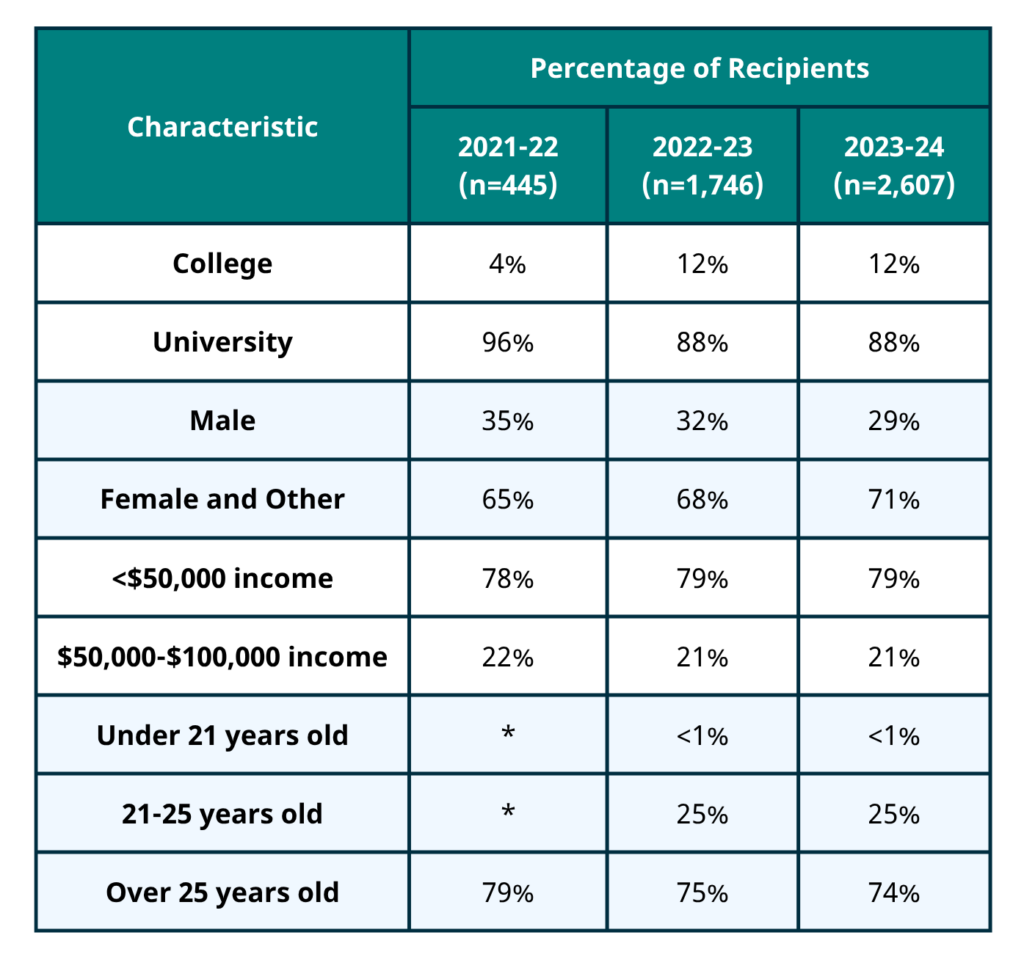
Note: The asterisk (*) indicates data that were suppressed where the number of recipients was fewer than three. Due to small cell size, Other was combined with Female.
Based on OSAP data, it appears learners have increasingly accessed OSAP to pursue eligible microcredential programs since 2021, with adult learners leading the way. Continuing to expand the number of OSAP-eligible microcredentials (which currently stands at about 2,300 programs) can help ensure more learners have access to these training opportunities.
While this offers a glimpse into microcredential uptake in Ontario, data that more broadly captures all microcredential learners would allow for a deeper analysis of trends and provide a more complete picture of who pursues and holds microcredentials in the province. Further consideration of the types of data — and the methods for collecting and sharing these data — could help us learn more about Ontario’s microcredential landscape. For example, while microcredentials remain relatively new, administrative or survey data that track learner outcomes in the labour market could help inform future microcredential policy and program development. To learn more about other types of data needed, check out HEQCO’s review of microcredentials in Ontario.