Challenges and Opportunities for Competency-based Education in Ontario was written by Laura Gallant, Jinisha Patel, Ryan Tishcoff and Julia Colyar, Higher Education Quality Council of Ontario.
New study explores the defining features of competency-based education, how it’s currently being implemented in Ontario and the challenges and opportunities for CBE in Ontario.
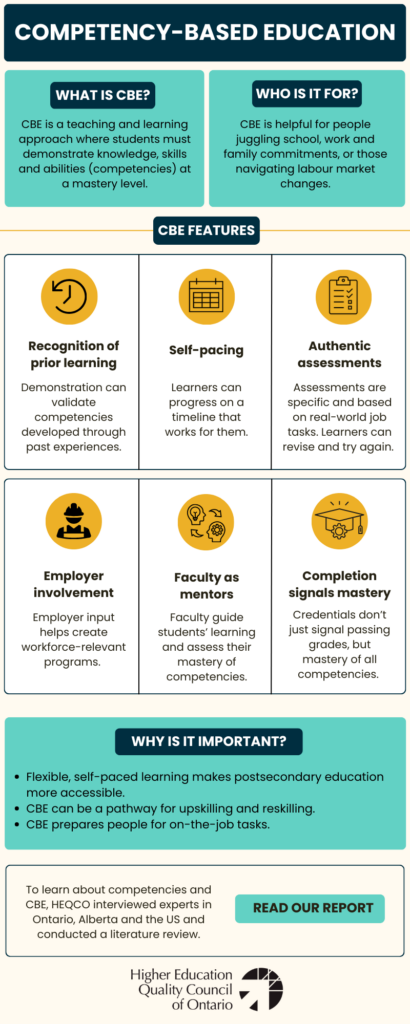
CBE is an educational delivery model rooted in accessibility and learner flexibility, focusing on the mastery of observable combinations of knowledge, skills and behaviours (known as competencies). Competence exists on a continuum of proficiency — from beginner to expert levels — where progression takes time and practice. A CBE approach to education allows learners to progress based on a performance-based assessments, rather than simply time spent in class. Non-traditional learners are often the target demographic for CBE programs, as most CBE learners are not entering their programs directly out of high school; instead, they are mature learners with some postsecondary education and work experience.
Through a literature review and interviews with CBE practitioners and experts in Ontario, Alberta and the US, HEQCO explored the meaning of competencies and the defining features of CBE. This study synthesizes information about CBE learners, program trends and lessons learned while implementing CBE in these jurisdictions. The key features of CBE include: recognition of prior learning and experience; self-pacing; authentic assessments with multiple attempts; employer and industry involvement; faculty as mentors; and the completion of a program signalling mastery of competencies.
Overall, HEQCO found that CBE can be understood as a continuum, where features of CBE and traditional programs often coexist. In Ontario, the most commonly used CBE features include employer involvement, faculty mentorship and authentic assessments with high thresholds for progression and completion. Ontario colleges and universities use the CBE model on various scales in career-focused programs in areas such as healthcare, education, trades and engineering, computer and information sciences. There are some challenges in implementing CBE programming in Ontario. For example, learning management systems do not always pair well with CBE. Seat time requirements, which should in theory be absent in CBE programs, are defined under the qualifications framework for Ontario postsecondary institutions. There can also be a struggle for faculty to orient students whose educational experiences have largely been in traditional classrooms to the CBE model.
In Ontario, CBE adoption is relatively new, and it operates on different scales. Despite the challenges in implementing it, CBE’s benefits and the alternative learning pathway it offers are conducive for upskilling and reskilling. Interviewees recommended that not all courses need or should incorporate CBE elements, and that relationship building and training can ease the transition to CBE where it is being applied. Knowledge building between CBE practitioners and those unfamiliar with CBE, along with amendments to policy frameworks related to institutional funding and student loans, could facilitate growth in CBE programming.